August 26, 2026 at 15:56 JST
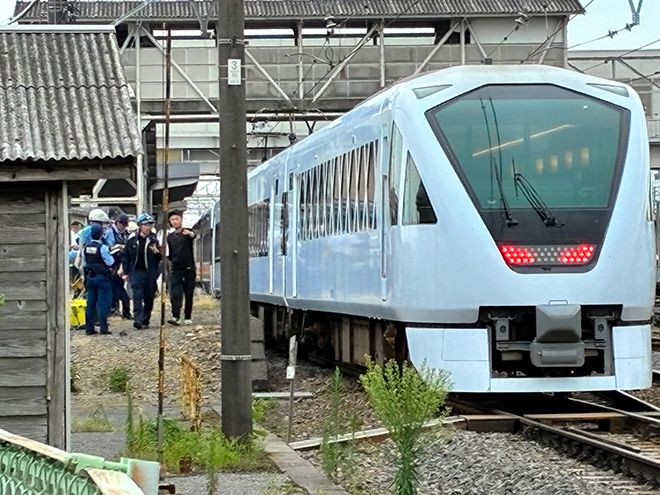
 A Tobu Railway Co. limited express train stops on the tracks after striking four workers. (Satoshi Okamoto)
There should be no repeat of an accident in which those working for safer railway operation lost their lives after being struck by a train.
Four workers were killed when a limited express train entered a Tobu Railway Co. station and struck them as they were spraying weed killers on the tracks.
Tobu Railway rules call for placing lookouts during work on or near the tracks and having them alert workers when a train approaches.
Doubts have been raised about a lack of proper communication between a lookout standing far from the station and the lookout nearer to where the accident occurred.
An investigation by police, the Japan Transport Safety Board (JTSB) and Tobu Railway will seek to determine the cause.
In past accidents of a similar nature, it was learned that company regulations for preventing accidents were not followed or that safety education was not thorough enough.
Tobu Railway’s safety management will be severely questioned.
In recent years, fatal accidents involving trains striking workers or lookouts have led to the death of a worker in 2023 in Toyama and Okayama as well as Shizuoka the following year and in Kagawa this past March.
We call on railway companies to re-examine their accident prevention measures.
The companies should thoroughly conduct measures beforehand that have been called for by the JTSB.
These include confirming before work begins the communications method to be used between workers and lookouts when a train approaches; having lookouts concentrate only on that duty; and conducting education and training so that signaling and evacuating when a train approaches can be carried out smoothly.
There will also be a need to strengthen measures.
For example, West Japan Railway Co. has installed a system utilizing GPS that notifies lookouts through their mobile devices with a warning sound or vibration whenever a train approaches.
One proposal might be to require other workers to also carry such devices to overcome possible communication breakdowns between lookouts and workers.
Mistakes will occur because humans are looking out and passing on information so there will be a need to implement accident prevention measures on the premise of human error.
But there will be limits to specific measures as long as work is done when trains are operating.
While it might be possible to shift that work to after train operations are concluded for the day, there will still be a need for warnings because cargo trains operate on some lines late at night.
Because of the repeated accidents, it is the responsibility of the central government to push for various measures conceived after considering the matter from different angles.
The four workers who were killed were trying to stop weeds from growing so that it would be easier for train drivers to notice irregularities on the tracks and for track workers to notice approaching trains.
The weed killing also prevents sparks from trains setting grass on the tracks on fire.
The fact that four employees who handled indispensable work for safe operations died should be viewed gravely and must lead to preventing a recurrence.
--The Asahi Shimbun, Aug. 25
4 workers struck, killed by luxury Spacia X train in Tochigi
August 20, 2026

JR companies upgrade worker safety as bear incidents hit high
July 18, 2026
Unstaffed bullet train platforms in Kyushu raise safety concerns
September 24, 2023
JR East adopting AI, drones to quickly restore train operations
July 8, 2026
Error in signaling system led to train crash that killed 275 people in India, official says
June 5, 2023
JR firms turn to robotics, AI to address labor crunch and aging
February 21, 2025


A peek through the music industry’s curtain at the producers who harnessed social media to help their idols go global.

A series based on diplomatic documents declassified by Japan’s Foreign Ministry

Here is a collection of first-hand accounts by “hibakusha” atomic bomb survivors.

Cooking experts, chefs and others involved in the field of food introduce their special recipes intertwined with their paths in life.

A series about Japanese-Americans and their memories of World War II



